

 24/7 365 days a year!
 Schedule
 +500 Positive Reviews
Should I Replace My AC in the Fall?
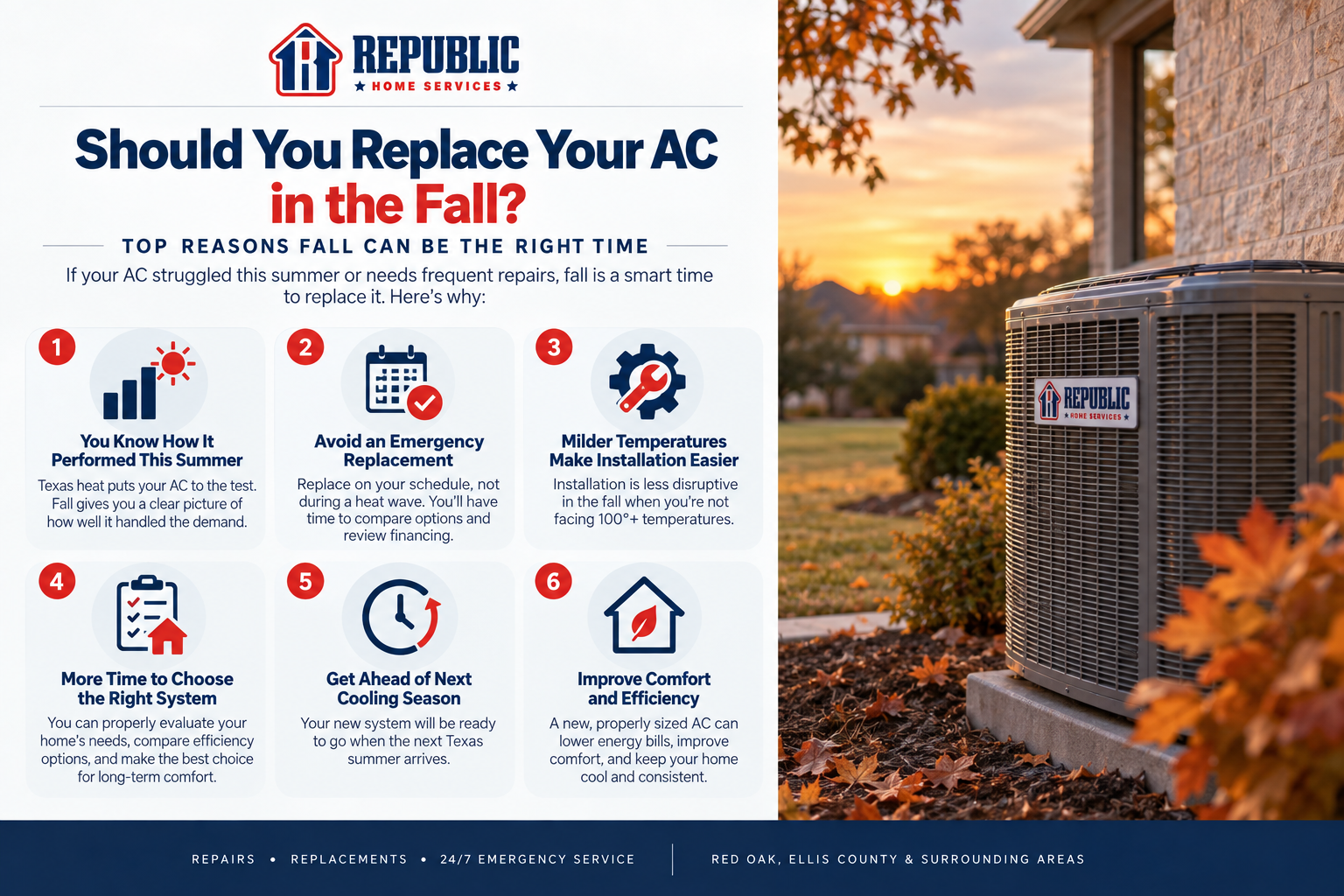
If your air conditioner struggles through the summer, needs constant repairs, or shows signs of declining performance, fall may be the right time to replace it. Replacing it before the next stretch of extreme heat gives you time to plan out your project instead of waiting for an emergency breakdown.
If your system cooled your home well all summer and hasn’t given you any trouble, you don’t need to replace it just because the season changed. However, if the summer was filled with warning signs that you need a new AC, fall gives you a window to address the problem before you need your air conditioner the most.
Why Fall AC Replacement Can Make Sense in Texas
North Texas summers put heavy demand on your cooling system. Triple-digit afternoon temperatures and weeks of heat force your AC to run for hours at a time, exposing weaknesses that stay hidden during milder months. Homeowners in milder climates only run their air conditioners for a few months a year. In Texas, the cooling season stretches across much of the calendar and rarely gives your equipment a break.
Summer is a stress test for your AC, revealing low capacity, slow refrigerant leaks, or compressors past their prime. Fall may be the best time to replace your AC because you know how your unit performed under the hardest conditions and have time to act before the next cooling season.
You Already Know How Your AC Handled the Texas Summer
Your system’s summer performance gives real evidence of its actual condition. Instead of relying on the age or brand, you get a firsthand account of how your equipment holds up in Texas summers.
Think back to the past few months and consider whether your AC:
- Ran almost constantly, with little or no downtime.
- Struggled to reach the thermostat setting on the hottest days.
- Left certain rooms consistently warmer than others.
- Corresponded with an unexpected increase in energy use.
- Required more than one repair.
- Started making new or strange noises.
- Stopped working entirely during extreme heat.
One issue doesn’t mean you need a new system, but several can signal that your equipment is nearing the end of its life. A professional evaluation from Republic Home Services can help you understand how many years your AC has left in it and whether replacement or cooling repairs make the most sense.
You Can Replace Your AC Before It Becomes an Emergency
Waiting until your air conditioner fails completely can mean making a major home-comfort decision under pressure. Planned replacement lets you choose with full information.
Choosing to replace your AC in the fall gives you time to:
- Have the existing system properly evaluated.
- Compare the cost of repair vs. replacement.
- Understand your equipment options.
- Consider efficiency levels.
- Review financing options before committing.
- Make sure the new system is properly sized for your home.
In North Texas, going without cooling during extreme heat can become a health and safety concern. Handling the replacement before you’re in the middle of a July heat wave keeps a manageable project from turning into an emergency replacement.
Milder Fall Temperatures Can Make Installation Less Disruptive
Replacing an AC means shutting down your existing cooling equipment while the new unit is installed. Scheduling replacement in October is much easier to manage than losing cooling in the middle of August.
Your home will be without air conditioning for a large part of the installation. Going without cooling on a 100-degree afternoon leaves your home hot and uncomfortable, while the same interruption during fall is barely noticeable.
You’ll Have More Time To Choose the Right AC
Replacing an air conditioner isn’t as simple as just buying a newer version of the unit you already have. The right system depends on your specific home and requires a proper evaluation to determine what will actually perform well in your house.
A thorough replacement evaluation should consider the following factors:
- Home size and square footage
- Layout
- Insulation levels
- Existing ductwork design
- Airflow throughout the house
- Current comfort problems
- System sizing
- Efficiency options
- Household needs
- Budget
Why proper AC sizing matters
Bigger isn’t always better for cooling systems. A system that’s too big cools the air quickly and satisfies the thermostat, but doesn’t run long enough to remove humidity from the air. You’ll have a cold, clammy house with a system that constantly switches on and off. An AC that’s too small has the opposite problem. It runs continuously and can’t catch up when temperatures peak.
Installing the wrong size system can leave you with:
- Uneven temperatures.
- Short cycling.
- Higher energy use.
- Excess equipment wear.
- Poor humidity control.
- Reduced comfort.
Proper sizing comes from a professional load calculation. If your old system was sized incorrectly to begin with, skipping that calculation and simply matching the tonnage of your existing unit carries the same problem into your new system.
You Can Address Comfort Problems Before Next Summer
Fall is the best time to investigate any comfort issues that showed up during the summer. Common problems homeowners notice during a Texas summer include:
- Rooms that stay hot regardless of the thermostat setting.
- Uneven cooling between floors.
- Weak airflow from certain vents.
- High indoor humidity levels.
- Cooling cycles that run long.
- Frequent on-and-off cycling.
- Difficulty holding the temperature during peak heat.
Installing a new air conditioner isn’t the answer for every comfort issue. Your home’s ductwork, insulation, airflow, thermostat placement, and system sizing can all contribute to these problems and keep them going even after a new system goes in. A professional evaluation can help you get to the root cause of each issue and ensure a fall AC replacement will actually fix it.
A New AC May Improve Energy Efficiency
Replacing older equipment with a properly sized modern air conditioner can reduce the energy needed to cool your home. How much it reduces depends on factors specific to your home.
Potential benefits you can see with newer equipment include:
- Improved cooling efficiency compared to older systems.
- More consistent temperatures throughout the home.
- More reliable operation and fewer breakdowns.
- Compatibility with modern thermostats and controls.
- Potentially lower cooling energy use.
Actual energy use depends on your system’s efficiency, whether it’s sized correctly, the condition of your ductwork, insulation levels, thermostat settings, and your household habits.
Fall Gives You Time to Plan for the Cost of Replacement
An HVAC replacement is a significant investment. Planning ahead lets you compare options instead of accepting the first quote you get during an emergency breakdown.
Taking the time allows you to:
- Understand HVAC replacement costs.
- Compare system options across efficiency levels.
- Review financing terms before committing.
- Check if any specials apply to your project.
- Decide which efficiency level fits your budget.
Deciding with full information puts you in a better position than choosing under pressure. At Republic Home Services, we offer financing options and seasonal specials that can help make your replacement more manageable.
Should I Replace My AC Before It Breaks?
Proactive air conditioner replacement makes more sense than waiting for a total failure, depending on your system’s condition. If you find yourself asking “Should I replace my AC?” consider if:
- Repairs are becoming more frequent.
- A major component needs repair.
- Cooling performance has noticeably declined.
- The AC struggles during extreme heat.
- Energy consumption is increasing without explanation.
- The system has recurring refrigerant or mechanical problems.
- The equipment is aging and experiencing multiple issues at once.
If your AC is functioning properly and just needs a simple repair, replacing it early means paying for capacity you already had. Professional diagnosis is the best way to determine your system’s condition, rather than using age alone to decide when to replace your air conditioner.
AC Repair vs. Replacement: How Do I Decide?
Deciding between AC repair vs. replacement depends on your system’s age, condition, and service costs.
AC repair may make sense when:
- The issue is relatively minor.
- The system has otherwise been reliable.
- Cooling performance remains good.
- Repairs haven’t become a recurring expense.
- Repair cost is reasonable compared with replacement.
AC replacement may make sense when:
- Repair costs are becoming substantial.
- Breakdowns happen more than once a season.
- A major component, such as the compressor, has failed.
- The AC can no longer keep the home comfortable.
- Efficiency and performance have noticeably declined.
- The system has multiple age-related problems.
How Long Do Air Conditioners Last in Texas?
No single lifespan applies to every air conditioner in Texas. How long your AC lasts largely depends on how it was installed and maintained throughout its lifespan.
The top factors that affect longevity include:
- How heavily the system runs each season.
- Maintenance history and consistency.
- Quality of the original installation.
- Equipment quality and build.
- Whether the system was sized correctly.
- Airflow and ductwork condition.
- Outdoor conditions and unit placement.
- The nature of previous repairs.
Because air conditioners in North Texas run heavily across long cooling seasons, maintenance and overall system condition carry more weight than they do elsewhere. A system with regular maintenance, proper airflow, and correct sizing will last longer than one without, regardless of the year it was installed.
What Should I Look for When Replacing My AC?
When replacing your air conditioner, focus on sizing and AC installation quality first. The equipment you choose matters, but a well-chosen system that’s installed poorly won’t perform as well as a more modest system installed correctly.
A few things to consider for your project include:
- Correct system sizing based on a load calculation.
- Energy-efficiency rating.
- Equipment type for your home and ductwork.
- Warranty coverage on equipment and labor.
- Contractor experience with North Texas homes.
- Ductwork condition and if it needs attention.
- Ongoing maintenance requirements.
- Your indoor comfort needs.
- Financing and payment options.
- Smart thermostat compatibility.
Don’t Wait for the First Heat Wave To Think About Your AC
If your air conditioner performed well all summer and remains reliable, there’s no reason to replace it simply because it’s fall. But if you spent this summer wondering whether your system would make it through, it’s worth looking at a replacement now rather than in June.
At Republic Home Services, we help homeowners across North Texas stay cool with AC inspections and diagnostics, repairs, replacements, new installations, HVAC maintenance, and more. If your air conditioner struggled this summer, schedule an evaluation with our experts to see whether it’s time to consider an upgrade.