
 24/7 365 days a year!
 Schedule
 +500 Positive Reviews
Why Is My Water Heater Running Out of Hot Water So Fast?
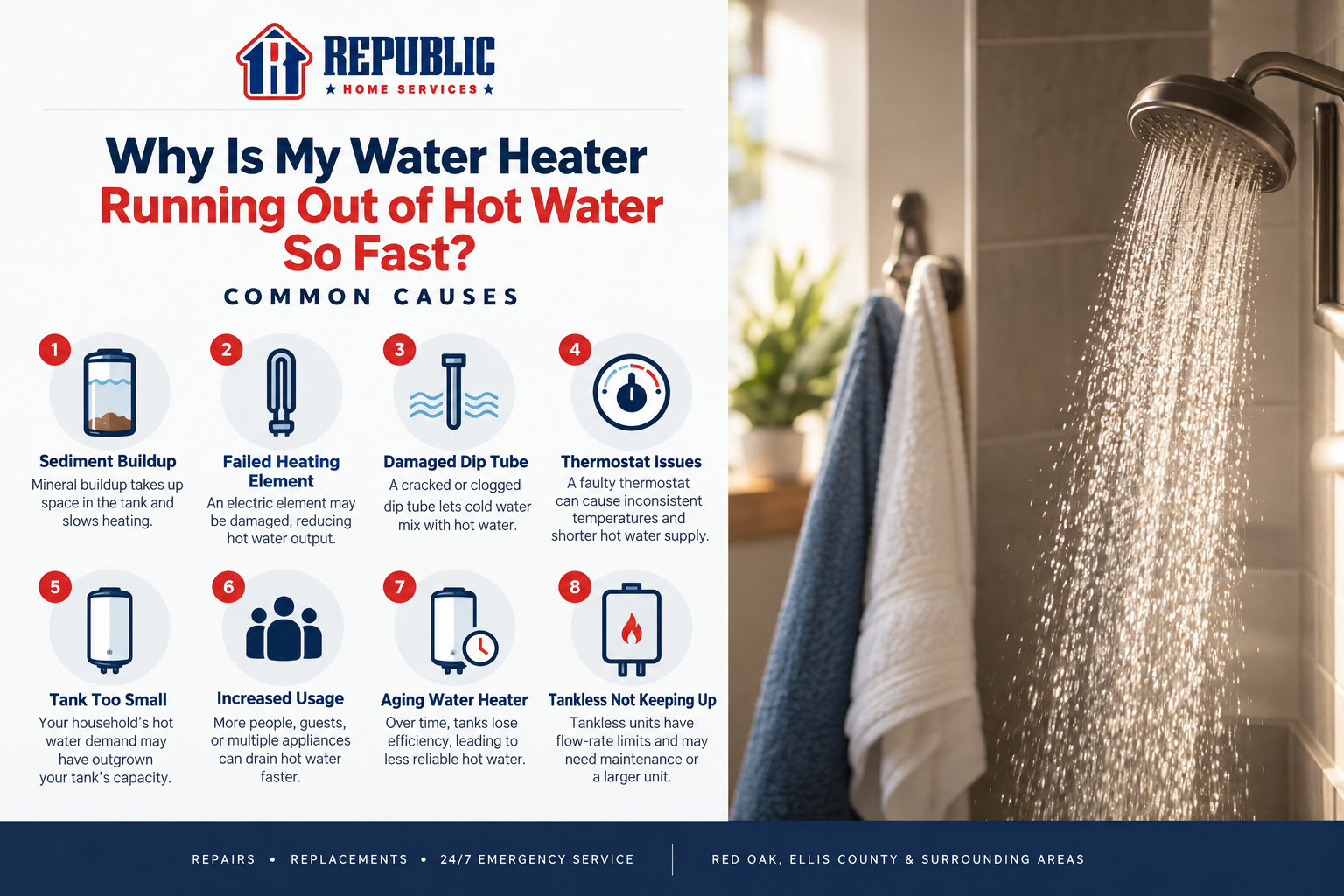
If your water heater’s running out of hot water faster than it used to, likely causes are sediment buildup, a failed heating element, a damaged dip tube, thermostat problems, an aging water heater, or a tank that’s too small for your household’s hot-water demand.
Running out of hot water after three showers and a load of laundry in an hour or two is a different problem from the water running cold during the first shower of the day. The first is a demand issue you can resolve by staggering your usage. If the second is a noticeable change in how long the hot water lasts, that’s indicative of a problem with your water heater.
Sediment Is Taking Up Space in Your Water Heater
Water heater sediment buildup is a common cause of water heater issues in North Texas due to the high levels of calcium and magnesium in our water, which come from limestone beneath the Blackland Prairie. At Republic Home Services, we constantly see this.
Every time this mineral-rich water is heated in the tank, some sediment settles at the bottom, taking up space that should be holding hot water, or lands between the burner and the water in a gas tank, which slows recovery.
All is not lost! Depending on the condition and type of your water heater, sediment buildup can be kept in check with routine flushing.
A Heating Element May Have Failed
An electric tank uses two water heater heating elements. If one fails, you’re not completely bereft of hot water. But that’s the problem. You’ll know the water heater is working because you’re getting lukewarm water, but you’ll notice temperature fluctuations, much longer reheat times, and you’ll find your hot water doesn’t last as long.
There’s also a seasonal element to consider. In Ellis County summers, water arrives already partly warmed from pipes beneath hot ground, and the tank has less to do. However, in January, much colder water enters the tank, and during severe winter weather — like this year’s winter storm — your water heater has to work harder to bring that water up to temperature, lengthening the time it takes to reheat the tank, and with one element, the issue is magnified.
This isn’t something to deal with yourself. Testing an element means working inside an energized panel, which requires professional experience and know-how.
The Dip Tube Could Be Damaged or Clogged
The dip tube carries incoming cold water to the bottom of the tank, where the burner can heat it. When a water heater dip tube cracks, breaks off short, or becomes clogged, cold water mixes directly into the hot water at the top of the tank, heading for your shower, making it seem like the hot water is running out quickly.
Your tank is fine, and your burner is working — it’s the water reaching your fixtures that’s been affected.
The Thermostat Isn’t Working Correctly
If your water heater’s not staying hot, it could be because your thermostat’s malfunctioning or has failed. The symptoms can look a lot like a failed heating element: water that never gets properly hot, temperatures that vary from one use to the next, and long waits while the tank recovers.
Check whether someone’s bumped the setting, but beyond that, thermostat work involves live electrical connections or the gas control valve, so have a licensed plumber test it.
Your Water Heater May Be Too Small for Your Household
If you, like many other folks in North Texas, are asking “why does my hot water run out so fast now?” it may not be because anything’s broken — it might simply be that your household’s asking for more hot water than before.
This comes up constantly in Red Oak. Newer subdivisions have tanks sized to floor plans, not families, and older homes on the FM roads still run 40-gallon units that suited two bedrooms and one bathroom but don’t suit the multi-generational families living in them today.
To work out whether your hot water heater is undersized, add up your busiest hour of hot-water use at roughly 20 gallons per 10-minute shower, 35 for a shallow bath, 7 per dishwasher cycle, and 25 for a top-loading washer, then compare that against the first-hour rating on your EnergyGuide label.
Your Hot-Water Usage Has Increased
While an undersized tank is a permanent mismatch, a temporary spike in demand is a different problem. Think back to whether it started when guests stayed over, someone new moved in, a teenager discovered long showers, a new baby (or twins!) was born, or a schedule change meant that you started using multiple fixtures or appliances at the same time.
If your water heater runs out of hot water quickly even after you’ve spread demand across the day, it’s time to bring in the experts.
Your Water Heater Is Aging
Age alone doesn’t mean you need a new hot water heater. A well-maintained 12-year-old tank may have plenty of life left, while a neglected eight-year-old tank may already be struggling.
If it’s wearing out, you’ll notice a difference in the reliability and delivery of your hot water, more frequent repairs, higher energy bills, rust-colored hot water, and even rumbling noises from your tank. At Republic Home Services, our technicians will assess your tank’s condition and advise you on whether continued repairs make sense.
What If My Tankless Water Heater Isn’t Keeping Up?
A tankless water heater heats water on demand, but it still has a limit. If it’s no longer keeping up with your household’s hot-water needs, it may need maintenance to remove sediment and scale from the mineral-rich water in Ellis County and Red Oak, a repair, or a larger unit if your demand has outgrown its capacity. The right fix depends on whether the problem is the heater or your hot water needs.
How Can I Make My Hot Water Last Longer?
You can make your hot water last longer by scheduling your use of showers, baths, and appliances. Showers use far less water than baths, and water-efficient shower heads help.
Staying ahead of maintenance matters more in North Texas than in most places because managing scale and sediment protects your water heater’s capacity and prolongs its life.
Should I Repair or Replace My Water Heater?
If you’re considering whether to repair or replace your heater, consider what makes the most sense based on the issue and your needs.
Water heater repair is the right path when the tank itself is sound, repairs haven’t been piling up, the problem is a replaceable component like an element, thermostat, or dip tube, and the cost is reasonable when compared to a brand-new unit.
Water heater replacement becomes the better call when the tank is corroded or leaking, repairs are getting more frequent — and costly — or when the unit no longer meets your household needs.
Either way, the experts at Republic Home Services will diagnose it first before providing you with our recommendation.
Would a Tankless Water Heater Keep Me From Running Out of Hot Water?
For households that keep running out of hot water, a tankless system that heats water on demand is worth considering. The caveat is that tankless units have flow-rate limits and must be sized to the house, the fixtures, and your family’s hot-water use. Much as an undersized tank can’t keep up, an undersized tankless unit also won’t meet your needs.
Get Your Hot Water Back With Republic Home Services
At Republic Home Services, we repair both tank and tankless systems, work on gas and electric models, handle water heater repair and replacement, and can identify sediment buildup, element failures, thermostat problems, and leaks.
We serve Red Oak, Ellis County, and surrounding North Texas communities, with 24/7 emergency service when it can’t wait until morning.
Many of us who experienced the February 2021 freeze remember what it’s like to lose hot water in a cold snap, and wanting to avoid a repeat is reason enough to check out your water heater now ahead of winter.
Contact us today if your hot-water supply has noticeably decreased, and let’s find out why.